
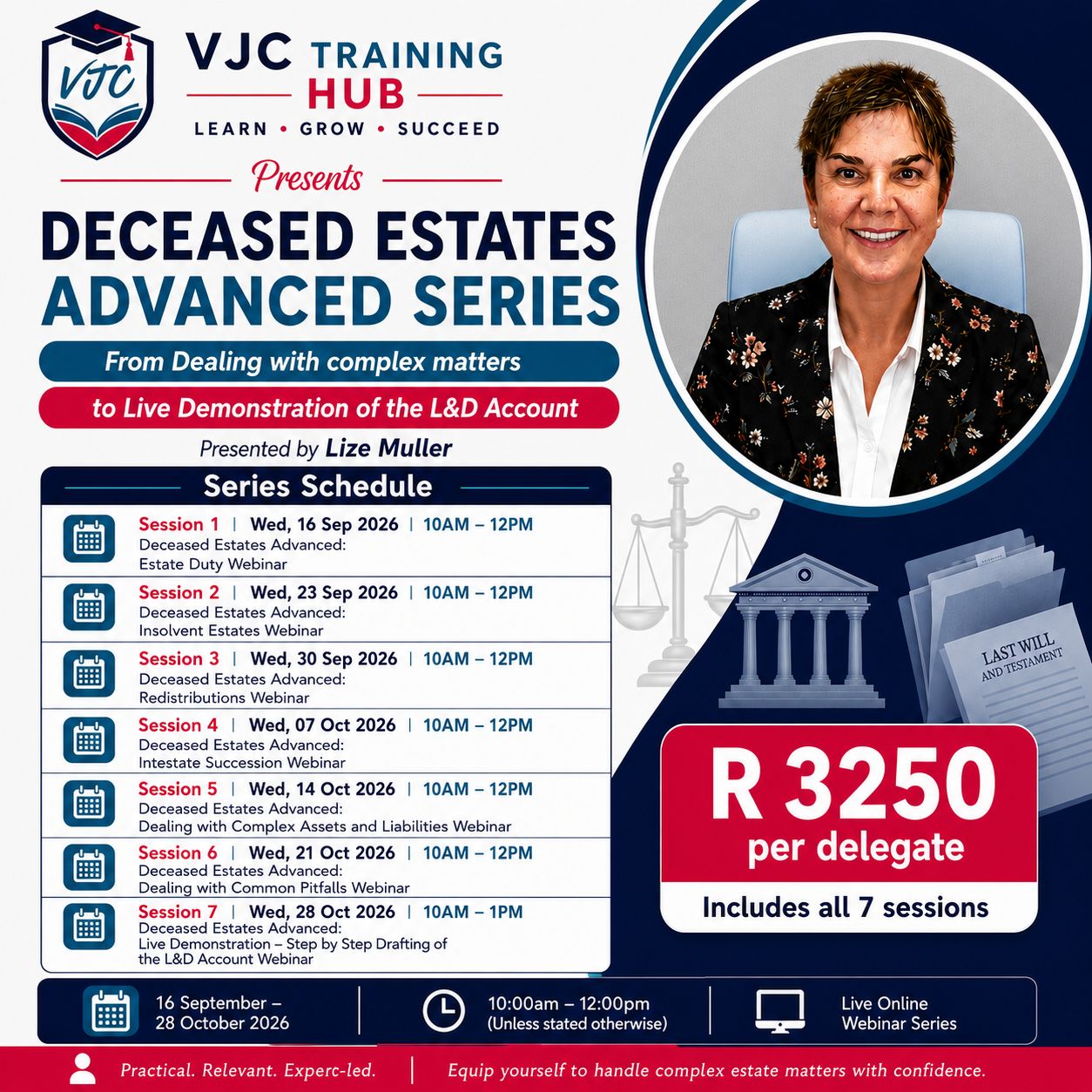
Deceased Estates Advanced Series: From Dealing with complex matters to Live Demonstration of the L&D Account - 7 x Session Webinar Series
This advanced 7-part webinar series is designed for practitioners, fiduciary professionals, estate administrators, accountants, legal support staff, and advisors who already understand the basic deceased estate administration process and now need to engage with more complex estate scenarios.
The series moves beyond introductory to estate administration and focuses on advanced issues that commonly delay, complicate, or derail deceased estate finalisation. Each session is structured as a focused 2-hour event and deals with a specific advanced topic, while also linking back to the practical preparation of the Liquidation and Distribution Account.
Across the series, attendees will work through Estate Duty, insolvent deceased estates, redistribution agreements, intestate succession, complex assets and liabilities, common administration pitfalls, and finally a live step-by-step demonstration of the drafting of a Liquidation and Distribution Account.
1. Deceased Estates Advanced: Estate Duty Webinar
This session focuses on Estate Duty as an advanced estate administration issue. Rather than dealing with SARS compliance generally, the session concentrates on what Estate Duty is, how Estate Duty is calculated, allocated, and reflected in the estate administration process.
The session explains the difference between estate property and deemed property, the treatment of life policies, the spouse deduction, the abatement, and the practical effect of Estate Duty on the liquidity and distribution of the estate.
Key Topics
- Estate Duty in the Estate Administration Process
- Where Estate Duty fits into the deceased estate timeline.
- Importance of Estate Duty being considered before distribution.
- Difference between estate liabilities, administration costs, and Estate Duty.
- SARS’ role in assessing Estate Duty.
- The executor’s responsibility for Estate Duty compliance.
- Determining the Gross Estate
- Property belonging to the deceased at date of death.
- Immovable property.
- Movable property.
- Bank accounts and investments.
- Business interests, shares, loan accounts, and member’s interests.
- Foreign assets.
- Digital and crypto assets.
- Accrual claims and matrimonial property consequences.
- Deemed Property
- Life policies on the life of the deceased.
- Policies payable to nominated beneficiaries.
- Policies payable to the surviving spouse.
- Buy-and-sell policies.
- Key-person policies.
- Retirement benefits and their estate consequences.
- Assets that does not fall within the deceased estate, but may still affect Estate Duty.
- Allowable Estate Duty Deductions
- Funeral and deathbed expenses.
- Debts due by the deceased.
- Administration costs.
- Executor’s remuneration.
- Claims against the estate.
- Bequests to qualifying public benefit organisations.
- Foreign asset-related deductions.
- Accrual claims.
- Other section 4 deductions.
- Surviving Spouse Deduction
- Section 4(q) deduction.
- Bequests to a surviving spouse.
- Life policies payable to a surviving spouse.
- Intestate inheritance by a spouse.
- Multiple spouses and customary law considerations.
- Why the spouse deduction often defers Estate Duty rather than eliminating it.
- Section 4A Abatement
- Application of the R3.5 million abatement.
- Rollover of unused abatement between spouses.
- Difference between deductions and abatement.
- Practical effect on the dutiable estate.
- Estate Duty Calculation
- Step-by-step Estate Duty calculation.
- Applying the current Estate Duty rates.
- Apportionment of Estate Duty between the estate and policy beneficiaries where applicable.
- Reflecting Estate Duty in the Liquidation and Distribution Account.
2. Deceased Estates Advanced: Insolvent Deceased Estates Webinar
Session Overview
This session deals with deceased estates where the liabilities exceed assets. Insolvent deceased estates require careful handling because the executor cannot simply proceed in the ordinary course of administration. The session explains how the executor identifies insolvency, reports it, communicates with creditors, and determines the appropriate administration route.
The focus is on the practical decision-making process and the risks that arise when an executor continues to administer an insolvent estate as if it were solvent.
Key Topics
- Identifying an Insolvent Deceased Estate
- Difference between illiquidity and insolvency.
- When an estate is unable to meet its liabilities.
- The importance of the section 29 creditors’ notice.
- Evaluating claims after expiry of the claims period.
- Distinguishing disputed, secured, preferent, and concurrent claims.
- Executor’s Duties When Insolvency Is Suspected
- Duty to investigate solvency.
- Duty to report insolvency to the Master.
- Risk of premature payments.
- Assessing each creditor’s claim.
- Executor’s potential personal liability.
- Reporting to the Master
- When the Master must be notified.
- Information to be submitted to the Master.
- How creditors must be notified.
- When to proceed under the Insolvency Act.
- Creditors and Ranking of Claims
- Secured creditors.
- Preferent creditors.
- Concurrent creditors.
- Funeral and administration expenses.
- SARS as a creditor.
- Maintenance claims.
- Bondholders and asset finance creditors.
- Assets in Insolvent Deceased Estates
- Sale of immovable property.
- Effect of bonded property.
- Vehicles under finance.
- Business assets.
- Household goods.
- Assets claimed by a surviving spouse or third party.
- Assets subject to security.
- Effect on Heirs and Beneficiaries
- Why heirs do not inherit until creditors are settled.
- Abatement of benefits.
- No distribution where estate is insolvent.
- Dealing with family expectations.
- Communicating difficult outcomes.
- Drafting Considerations
- How insolvency affects the Liquidation and Distribution Account.
- Reflecting claims and asset realisations.
- Administration costs.
- Shortfalls.
- Finalising an estate with no residue for heirs.
3. Deceased Estates Advanced: Redistribution Agreement Webinar
Session Overview
This session focuses on Redistribution Agreements in deceased estates. Redistribution Agreements are often misunderstood and incorrectly used. The session explains when redistribution is appropriate, who must consent, how it affects heirs, and how the redistribution must be reflected in the Liquidation and Distribution Account.
Key Topics
- What Is a Redistribution Agreement?
- Meaning of redistribution in deceased estate administration.
- Difference between inheritance, sale, donation, and redistribution.
- Why redistribution is not simply an informal family arrangement.
- When redistribution may be useful.
- When redistribution should be avoided.
- Legal Requirements
- Parties who must consent.
- Capacity of heirs and beneficiaries.
- Minor beneficiaries.
- Beneficiaries under curatorship.
- Trusts as beneficiaries.
- Married heirs and spousal consent considerations.
- Written agreement requirements.
- Redistribution in Testate Estates
- Redistribution where there is a valid will.
- Altering the practical effect of a will.
- Respecting the testator’s intention.
- Risks of contradicting the will.
- Specific bequests and redistribution.
- Redistribution in Intestate Estates
- Redistribution between intestate heirs.
- Surviving spouse and descendants.
- Customary law and multiple-spouse scenarios.
- Minor children and Guardian’s Fund implications.
- Equalisation between heirs.
- Immovable Property Redistributions
- Awarding property to one heir.
- Cash equalisation payments.
- Bonded properties.
- Transfer documents.
- Transfer duty and conveyancing considerations.
- SARS and municipal clearance issues.
- Tax and Cost Consequences
- Capital gains tax considerations.
- Transfer duty considerations.
- Donations tax risk.
- Estate Duty impact, where relevant.
- Conveyancing fees.
- Executor’s fee implications.
- Liquidity consequences.
- Drafting the Redistribution Agreement
- Key clauses in a Redistribution Agreement.
- Identifying the estate assets.
- Identifying the original entitlement.
- Recording the agreed substituted entitlement.
- Equalisation payments.
- Warranties and acknowledgements.
- Signatures and supporting documents.
- Reflecting Redistribution in the L&D Account
- Showing redistribution.
- Explaining the redistribution in the account.
- Attaching the agreement.
- Avoiding ambiguity in awards.
- Handling objections.
- Practical Component
4. Deceased Estates Advanced: Intestate Succession Webinar
Session Overview
This session deals with deceased estates where the deceased died without a valid Last Will and Testament, or where the will does not dispose of the whole estate. The session focuses on identifying lawful heirs, calculating intestate shares, dealing with spouses and descendants, and addressing complications involving customary marriages, adopted children, minor heirs, predeceased descendants, and partial intestacy.
Key Topics
- When Intestate Succession Applies
- No valid will.
- Invalid or revoked will.
- Partial intestacy.
- Failed bequests.
- Beneficiary predeceasing the deceased.
- Uncertainty or ambiguity in a will.
- Residue not properly disposed of.
- Legal Framework
- Intestate Succession Act.
- Role of the Master.
- Importance of family information.
- Next-of-kin affidavits.
- Proof of relationships.
- Documentary evidence required.
- Identifying Heirs
- Surviving spouse.
- Descendants.
- Parents.
- Siblings.
- Descendants of predeceased siblings.
- More remote blood relatives.
- Adopted children.
- Children born outside marriage.
- Surviving Spouse and Descendants
- Where the deceased leaves a spouse but no descendants.
- Where the deceased leaves descendants but no spouse.
- Where the deceased leaves both spouse and descendants.
- Child’s share calculation.
- Statutory inheritance of the surviving spouse.
- Multiple spouses.
- Customary Marriages and Multiple Spouses
- Recognition of customary marriages.
- Proof of customary marriage.
- Multiple surviving spouses.
- Calculating the spouses’ shares.
- Interaction with descendants.
- Practical documentation challenges.
- Minor Heirs
- Minor children as heirs.
- Guardian’s Fund implications.
- Natural guardian versus legal representative.
- Heirs under curatorship.
- Trusts created for minors.
- Master’s requirements.
- Partial Intestacy
- Where part of the estate is governed by a will and part by intestate succession.
- Failed residue clauses.
- Lapsed benefits.
- Renunciation and repudiation.
- Redistribution versus intestate allocation.
- Drafting the Intestate Distribution
- Preparing the distribution schedule.
- Calculating shares.
- Explaining child’s share.
- Recording heirs correctly.
- Avoiding incorrect exclusion of heirs.
- Supporting documents to attach.
5. Deceased Estates Advanced: Dealing with Complex Assets and Liabilities Webinar
Session Overview
This session focuses on assets and liabilities that complicate deceased estate administration. The aim is to help practitioners identify, value, secure, realise, transfer, or account for complex estate items.
The session covers immovable property, business interests, farms, loan accounts, foreign assets, digital assets, trusts, contingent liabilities, suretyships, tax liabilities, and disputed claims.
Key Topics
- Complex Immovable Property Issues
- Bonded property.
- Co-owned property.
- Property in sectional title schemes.
- Farms and agricultural property.
- Property subject to usufruct or habitation.
- Rates, levies, and municipal debts.
- Sale versus transfer to heirs.
- Business Interests
- Shares in private companies.
- Member’s interests in close corporations.
- Sole proprietorships.
- Partnerships.
- Buy-and-sell agreements.
- Shareholder agreements.
- Valuation of business interests.
- Continuity of business operations after death.
- Trust-Related Issues
- Assets owned by a trust versus assets owned by the deceased.
- Loan accounts in favour of or owing by the deceased.
- Deceased as trustee.
- Deceased as beneficiary.
- Trust distributions after death.
- Mistaken inclusion of trust assets in the estate.
- Foreign Assets
- Identifying offshore assets.
- Foreign bank accounts and investments.
- Foreign immovable property.
- Exchange control considerations.
- Foreign probate or resealing requirements.
- Foreign tax and double taxation issues.
- Reporting foreign assets in the estate.
- Digital and Crypto Assets
- Identifying digital assets.
- Crypto wallets and exchange accounts.
- Access and security issues.
- Valuation at date of death.
- Realisation or transfer.
- Estate Duty and CGT considerations.
- Practical risks for executors.
- Retirement Funds and Employee Benefits
- Pension, provident, preservation, and retirement annuity funds.
- Death benefits outside the estate.
- Section 37C-type decision-making by retirement funds.
- Difference between estate assets and nominated beneficiaries.
- Tax certificates and estate reporting.
- Complex Liabilities
- Mortgage bonds.
- Vehicle finance.
- Suretyships.
- Business debts.
- Personal loans.
- Maintenance claims.
- SARS liabilities.
- Disputed claims.
- Contingent liabilities.
- Claims by surviving spouses or former spouses.
- Valuation and Record-Keeping
- Date-of-death valuations.
- Business valuations.
- Property valuations.
- Supporting documents.
- Preparing for Master and SARS queries.
6. Deceased Estates Advanced: Dealing with Common Pitfalls Webinar
Session Overview
This session deals with the mistakes that most frequently delay the administration of a deceased estate, trigger Master’s queries, create SARS problems, or expose executors to complaints and liability.
The session is practical and risk-focused. It draws together the issues from the previous sessions and shows how to prevent common errors before they occur.
Key Topics
- Reporting and Appointment Pitfalls
- Incomplete reporting documents.
- Incorrect death notice information.
- Missing wills or uncertified wills.
- Disputes over executor appointment.
- Delays in obtaining Letters of Executorship.
- Acting before appointment.
- Distinguish between Letters of Authority and Letters of Executorship.
- Advertisement and Claims Pitfalls
- Incorrect section 29 advertisement.
- Failure to advertise in the correct newspaper.
- Late claims.
- Ignoring disputed claims.
- Paying creditors too early.
- Distinguish between secured, preferent, and concurrent creditors.
- Asset Identification Pitfalls
- Omitting assets.
- Including assets that is not an estate asset.
- Joint estate assets.
- Trust assets.
- Failure to identify foreign or digital assets.
- Incorrect date-of-death values.
- Liability Pitfalls
- Ignoring SARS liabilities.
- Failing to provide for administration costs.
- Not accounting for executor’s remuneration.
- Incorrect bond settlement calculations.
- Overlooking maintenance claims.
- Failing to identify suretyship exposure.
- Treating disputed claims as final without full and correct information and documenation.
- Estate Duty and Tax Pitfalls
- Incorrect treatment of life policies.
- Failure to include deemed property.
- Incorrect spouse deduction.
- Incorrect abatement application.
- Failure to distinguish deceased tax from estate tax.
- Distributing before SARS compliance is finalised.
- Not providing for CGT or post-death income tax.
- Distribution Pitfalls
- Incorrect heir identification.
- Incorrect intestate calculations.
- Ignoring minor heirs.
- Misapplying redistribution agreements.
- Awarding assets without consent.
- Distributing before the L&D Account has laid for inspection.
- Paying heirs before all liabilities are settled.
- L&D Account Drafting Pitfalls
- Incorrect account structure.
- Incorrect descriptions of assets.
- Missing vouchers or supporting schedules.
- Incorrect income and expenditure account.
- Failure to balance cash.
- Poor explanation of awards.
- Inadequate notes to the account.
- Not responding properly to Master’s queries.
- Executor Risk Management
- Keeping proper records.
- Communicating with heirs and creditors.
- Avoiding conflicts of interest.
- Managing expectations.
- Documenting decisions.
- When to obtain specialist advice.
- When to approach the Master for directions.
7. Deceased Estates Advanced: Live Demonstration – Step by Step Drafting of the L&D Account Webinar
Session Overview
The final session is a practical live demonstration. It brings together the full series by showing how to draft a Liquidation and Distribution Account from a set of deceased estate facts.
The demonstration follows a step-by-step approach and shows how assets, liabilities, income, expenditure, Estate Duty, heirs, Redistribution Agreements, and awards are reflected in the account.
Key Topics
- Purpose and Structure of the L&D Account
- Why the L&D Account is required.
- What the account must achieve.
- Relationship between the account, the Master, SARS, creditors, and heirs.
- Core sections of the account.
- Supporting schedules and vouchers.
- Estate Facts and Source Documents
- Death notice.
- Will or intestacy information.
- Letters of Executorship.
- Inventory.
- Bank statements.
- Valuations.
- Creditor claims.
- SARS information.
- Policy documents.
- Property documents.
- Beneficiary details.
- Drafting the Liquidation Account
- Listing estate assets.
- Showing date-of-death values.
- Showing realisation values.
- Dealing with immovable property.
- Dealing with movable property.
- Dealing with investments.
- Dealing with life policies.
- Dealing with business interests.
- Dealing with excluded or non-estate assets.
- Drafting the Liabilities Section
- Funeral expenses.
- Administration expenses.
- Executor’s remuneration.
- Master’s fees.
- Conveyancing costs.
- Bond liabilities.
- SARS liabilities.
- Creditor claims.
- Maintenance claims.
- Contingent or disputed liabilities.
- Estate Duty and Tax in the Account
- Reflecting Estate Duty.
- Reflecting SARS income tax liabilities.
- Reflecting refunds.
- Dealing with post-death income tax.
- Showing tax as an administration expense where appropriate.
- Income and Expenditure Account
- Post-death income.
- Interest.
- Rental income.
- Dividends.
- Post death estate expenses.
- Bank charges.
- Property expenses.
- Maintenance of estate assets.
- Net income available for distribution.
- Distribution Account
- Identifying heirs and beneficiaries.
- Testate distribution.
- Intestate distribution.
- Specific bequests.
- Residue.
- Redistribution agreement.
- Cash awards.
- Property awards.
- Awards to minors.
- Guardian’s Fund payments.
- Equalisation payments.
- Recapitulation Statement
- Balancing the account.
- Ensuring assets, liabilities, income, and distribution reconcile.
- Checking cash sufficiency.
- Identifying shortfalls.
- Final review before submission.
- Common Master’s Queries on L&D Accounts
- Missing vouchers.
- Incorrect calculations.
- Missing consent documents.
- Incorrect heir descriptions.
- Unclear awards.
- Missing approved and accepted Redistribution Agreement.
- Incorrect allocation of policies.
- Incorrect Estate Duty reflection.