
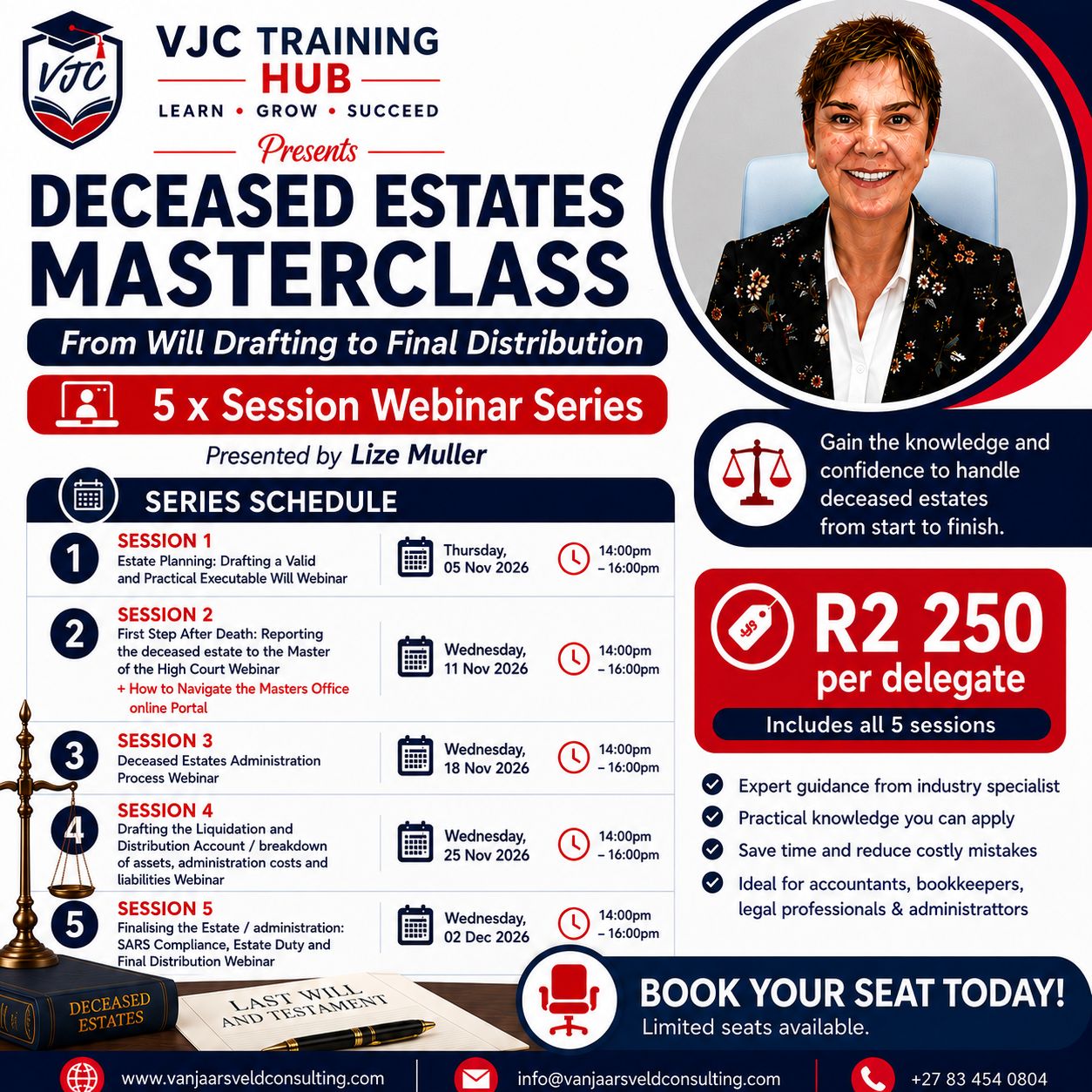
Deceased Estates Masterclass: From Will Drafting to Final Distribution - 5 x Session Webinar Series
Series Overview
The administration of a deceased estate can feel overwhelming as it combines complying with legal formalities, Master’s Office requirements, document management, beneficiary communication, asset gathering, creditor management, SARS compliance, and final distribution.
This practical five-part webinar series is designed to guide learners through the full deceased estate administration process in a structured, applied and confidence-building way.
By the end of the series, learners should be able to:
identify whether an estate is testate or intestate;
assess whether a will complies with all legal formalities;
prepare the required core reporting documents for the Master of the High Court;
distinguish between Letters of Executorship and Letters of Authority;
manage the post-appointment administration process;
compile the key information and documentation required needed for the Liquidation and Distribution Account;
understand the SARS compliance process and the basic Estate Duty calculation;
avoid common administrative delays and document errors.
1. Estate Planning: Drafting a Valid and Practical Executable Will Webinar - 24 June 2026 - 10AM-12PM
This session sets the foundation for effective estate administration by showing how a properly drafted will can prevent uncertainty, disputes, delays and unnecessary costs after death.
Learning outcomes
By the end of this session, learners should be able to:
explain why a valid will is central to estate planning and administration;
identify the statutory formalities for a valid will;
understand who may make, sign and witness a will;
recognise common drafting mistakes that create problems for executors and the administration process;
advise clients on regular will reviews and asset record-keeping;
understand the impact of marriage, divorce, annulment and life changes on estate planning
Key topics
Purpose and importance of a will
Testate versus intestate succession
Competency to make a will
Requirements for signing and witnessing a will
Statutory formalities under section 2 of the Wills Act 7 of 1953
What happens when a will does not comply with formalities
Court’s powers condonation under section 2(3) of the Wills Act
Effect of divorce or annulment on a will
Executor nomination and practical drafting considerations
Bequests, heirs, legatees and residue clauses
Cremation, burial wishes and organ donation instructions
Why clients should review wills and asset lists annually
2. First Step After Death: Reporting the deceased estate to the Master of the High Court Webinar - 01 July 2026 - 10AM-12PM
This session walks learners through the first practical steps after death, with a focus on correct reporting, complete documentation, and avoiding delays in obtaining the issuing of Letters of Executorship or Letters of Authority.
Learning outcomes
By the end of this session, learners should be able to:
identify which estates must be reported to the Master;
distinguish between estates requiring Letters of Executorship and section 18(3) estates requiring Letters of Authority;
prepare the required reporting documents;
identify the supporting documents required from the family, nominated executor or representative;
understand the difference between testate and intestate reporting requirements;
reduce delays caused by incomplete or incorrect documentation.
Key topics
What happens immediately after death
When and where to report a deceased estate
Role of the Master of the High Court
Testate estates versus intestate estates
Estates above and below the section 18(3) threshold
Letters of Executorship versus Letters of Authority
Required information and supporting documents
Completing the Death Notice
Completing the Inventory
Acceptance of Trust as Executor
Master’s Directions for section 18(3) smaller estates
Next of Kin affidavit
Nomination documents in intestate estates or where an alternative executor is needed
Submitting reporting documentation to the Master of the High Court
Common reasons the Master rejects or delays applications
3. Deceased Estates Administration Process Webinar - 08 July 2026 - 10AM-12PM
This session moves learners from appointment to fulfilling the fiduciary duties of an Executor. It focuses on gathering assets, identifying liabilities, communicating with institutions, managing creditors and preparing the required Liquidation and Distribution Account.
Learning outcomes
By the end of this session, learners should be able to:
Understand the executor’s duties;
identify and gather estate assets;
establish liabilities and creditor claims;
understand when creditors are paid;
communicate effectively with banks, insurers and other institutions;
manage common asset categories such as bank accounts, vehicles and immovable property;
understand the difference between the administration where Letters of Executorship is issued in full estates and smaller section 18(3) estates.
Key topics
Executor’s fiduciary duties after Letters of Executorship are issued
Master’s Representative duties after Letters of Authority are issued
Gathering estate assets
Opening an estate late bank account
Identifying bank accounts, investments and insurance policies
Communicating with financial institutions
Creditor claims and statutory notices
When and how creditors are paid
Vehicles in deceased estates
Immovable property in deceased estates
Bonded property and surviving spouse considerations
Practical communication with heirs and family members
Gathering required documentation / information
4. Drafting the Liquidation and Distribution Account / breakdown of assets, administration costs and liabilities Webinar - 15 July 2026 - 10AM-12PM
This session helps learners understand the required structure and practical preparation of the Liquidation and Distribution Account, including the Master’s inspection process and the implications for heirs, creditors and surviving spouses.
Learning outcomes
draft the required the Liquidation and Distribution Account;
understand when the account must be lodged;
identify the information and documentation required for drafting the account;
understand the required structure of the account;
distinguish between assets, liabilities, administration costs and distributions;
understand the inspection process;
identify common drafting and calculation errors.
Key topics
The Liquidation and Distribution Account
Section 35 of the Administration of Estates Act 66 of 1965
Six-month lodgement requirement after Letters of Executorship
Schedule 4 and Regulation 5 requirements
Assets to be reflected in the account
Liabilities and creditor claims
Administration costs
Executor’s fees and estate costs expenses
Cash shortfalls and cash contributions
Outstanding bonds and immovable property
Surviving spouse and co-owner considerations
the account lying open for inspection
Magistrate’s Court inspection process
Master’s queries;
and objections
Preparing for distribution after approval
5. Finalising the Estate / administration: SARS Compliance, Estate Duty and Final Distribution Webinar - 22 July 2026 - 10AM-12PM
This session brings the process together by showing learners how SARS compliance, Estate Duty, tax clearance and final distribution fit into the closing stages of estate administration.
Learning outcomes
By the end of this session, learners should be able to:
understand the SARS compliance steps in a deceased estate;
distinguish between the deceased’s personal tax obligations and the estate’s tax obligations;
identify outstanding returns and post-death income issues;
understand the basic Estate Duty calculation;
identify common deductions and exemptions;
understand why SARS compliance is required before finalisation;
prepare for final distribution and finalisation of the estate.
Key topics
SARS process after death
Outstanding returns up to date of death
Creating an income tax profile for the estate
Income and expenses after death
Deregistering the deceased’s personal SARS profile
Estate Duty overview
Estate Duty calculation framework
Section 4(q) surviving spouse deduction
Maintenance claims
Policies paid directly to third parties
Administration costs
Other deductions and exemptions
Transfer duty considerations
SARS tax as an administration cost
SARS compliance before distribution
Final distribution to heirs
Finalising the administration of the estate